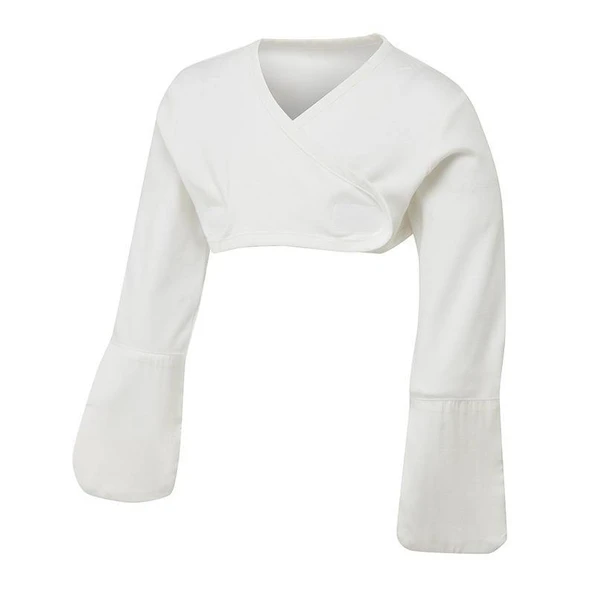





Swaddling is a great way to stop babies scratching the eczema on their face. If only you can stop them from escaping in the middle of the night! We kept our scratchy, eczema baby swaddled until he was well over eight months old albeit after a fair bit of experimentation.
Although not everyone agrees with swaddling, this practice has been used across the world throughout history. Swaddling can be really helpful for eczema babies. The most obvious benefit is that the swaddle keeps scratchy hands out of mischief. Also, the feeling of security from being swaddled can settle itchy babies, helping them sleep through the itch.
Our baby eczema story
Baby eczema usually appears when babies are between two and four months old. This is just the time babies are starting to escape from the traditional ‘wrap-round and tuck-in’ swaddles.
Our secret weapon was a tailored swaddle blanket from SwaddleMe. The two large Velcro fastenings made it really difficult for our very determined son to break out. The shaped shoulders reduced the gap around his neck, limiting his ability to wriggle a hand out and up to his face. It took a bit of experimentation to find an effective fastening pattern. We settled on securing one tab above his elbows and the other below. The fuzzy Velcro areas are big enough to give plenty of scope for adjustment.
We also discovered that he found the micro-fleece swaddle blankets much harder to escape from than the cotton versions. Probably because they are less stretchy. Unlike a lot of swaddle blankets SwaddleMe make larger sizes which we used until he was about nine-months-old. By this time, he was starting to get a hand out of his swaddle and (thankfully) we had perfected ScratchSleeves so could rely on them to protect his eczema from night-time scratching.

Swaddling safely
Only swaddle from newborn
Current advice from NCT is that swaddling should only be introduced when your baby is a newborn. You should not to start swaddling later in life, especially at around three months when the SIDS (cot death) risk is greatest. If you have not swaddled you baby regularly before their eczema appeared, it is best not to use swaddling them to control their hands. Instead, we suggest that you use ScratchSleeves to stop your baby scratching their face. If they had been in existence when our son’s eczema developed, we would probably not have continued swaddling him for so long.Watch out for overheating
Overheating is an often quoted risk associated with swaddling. However, if you keep your child’s room cool (the NHS advises between 16 and 20 degrees Celsius) and dress them sensibly under their swaddling blanket this risk is easily mitigated. It’s worth noting that adults (especially tired ones) are not good at estimating room temperature. It’s sensible to invest in a room thermometer. Babies lose excess heat through their head so don’t cover your baby’s head hen they are swaddled. Also, make sure that their feet are at the foot of the cot (‘feet to foot’). This means that there is plenty of space around their head for air to circulate. Watch out for cuddly toys that can be snuggled into.Allow natural hip movement
An infant’s natural hip position is ‘frog’ style – with legs drawn up and thighs roughly at right angles to the body. This helps the ball and socket joint develop properly in the hip. There is some evidence that ongoing swaddling with legs ‘straight down’ prevents this joint developing properly causing hip dysplasia. An article on the International Hip Dysplasia Institute’s website about a recent medical study states that ‘infant swaddling with any restriction of leg movement may harm unstable hips.’ The tailored swaddling blankets can be fastened securely around the arms while leaving plenty of space for the natural movement of the legs. The International Hip Dysplasia Institute recommends that infant hips should be positioned in slight flexion and abduction during swaddling.‘Back to sleep’
NEVER place a swaddled baby on their stomach and stop swaddling as soon as your little one can roll over, in any direction, by themselves.Be consistent
Make sure that everyone looking after your baby knows how they usually sleep and how they are swaddled. We know of one grandma who didn’t put her granddaughter’s ScratchSleeves on her the night before her christening….- Thinking about letting your itchy little one sleep in your bed? Read our post on the pros and cons of co-sleeping with an eczema baby.
Our sources
- Kingston Hospital NHS Trust – Article on Safe sleeping guide for babies under 1 year old. (May 2021)
- National Childbirth Trust – Article on Swaddling a baby: the benefits, risks and seven safety tips
- International Hip Dysplasia Institute – Article on New Warning about Swaddling
- International Hip Dysplasia Institute – Article on Understanding Hip Dysplasia: Infant & Child – Hip-Healthy Swaddling
Here at ScratchSleeves we don’t just share our experiences of bringing up an eczema child and favourite allergy friendly recipes, we also manufacturer and sell our unique stay-on scratch mitts and PJs for itchy babies, toddlers and children. We now stock sizes from 0-adult in a range of colours. Visit our webshop for more information.